Design, too, projects itself into the future. Is there a link between the two?
The two laws of thermodynamics – the conservation of energy and entropy – are fundamental to describing our world. Yet they introduce an inescapable path towards chaos. In response, the notion of negentropy accounts for the emergence of life and, by extension, of information.
Applying the concept of negentropy to design matches no existing adjective.
Built from the prefix non- (absence) and the suffix -illion (a lot), “nonillionaire” seems to be everything and its opposite. Its chaotic nature only takes on real meaning when negentropy is deliberately added to it. As Life does, let us try to multiply “absence” and “a lot”.
This “wealth of nothing” becomes the “wealth of (next to) nothing”:
The most traditional approach to design is:
When a product has answered the user’s problem particularly well, a strong bond is created.
Sold by beigebeigebeige, the BI-CYCLE indoor worm composter comes with a watering can whose design follows the precept “form follows function”.
It just has a little something extra: an inscription on its edge.

You have never before seen a product ask its user a question.
From useful and efficient, it becomes interesting and stimulating.
It creates a unique bond that is only activated if the user puts in some energy themselves. As soon as the user chooses to invest energy – by making an effort – they will seek a return on that investment, creating a unique bond between the two parties.
We have gone from a question written on the edge of a product to a reflection on the energy brought into play by the user.
The prerequisite is that information – a question, for example – is energy.
Physics cannot be wrong, and indeed a minimum thickness is needed to ensure the watertightness the product requires as a watering can. Material cannot be removed without degrading this characteristic of the product.
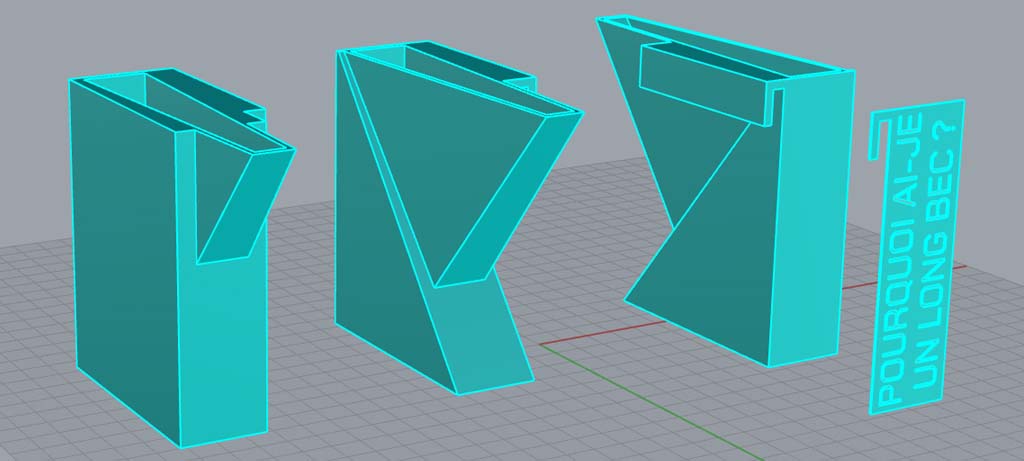
Information really is “extra material”, and therefore energy: here, the outline of the text cut into a thin additional layer of material (see below, image on the right).
First of all, we have to admit that this simple question written on the side of a watering can has made us question:
– the absence of any precedent, and the reasons for it,
– how we feel and behave in response to the question asked (investment),
– our medium-term bond with the product,
– and the reality of the founding laws of thermodynamics in our daily lives.
We may also note that a text applied to an ordinary product can be a reference, in modern history, to Marcel Duchamp’s “ready-mades”.
Since the product imposes its question on us, isn’t it trying to cheat? Fake news? Visually, the spout certainly looks long, but the shape clearly exaggerates it: if you extend the rectangle of the base upwards (see image on the left, above), the spout is no longer quite as long (as in the middle image).
Another trap: the “general” answer is composite. Most watering cans have a long but thin spout so they can reach the base of the plant precisely (form follows function). A cylinder wastes less material during manufacturing than a cone (funnel-shaped); nevertheless, watering cans have a half-funnel added on top so they can be carried as full as possible without spilling when you start watering.
In this example, the reason for the long spout has nothing to do with the constraints of other watering cans: it simply comes from a physical limitation of additive manufacturing when you do not want to use supports. It cannot print over empty space, but it can print overhanging the filament below. So the only way to close a box is to grow a surface at 45°, which here is the inner surface of the spout. This is not common knowledge.